Islamic Art Includes Elaborate Calligraphy Because It Enhances the Images of People
Arabic calligraphy:
Aboriginal arts and crafts,
mod art
The art of Arabic calligraphy has been enhanced and adult over the course of a millennia. It has written the word of God, helped preserve human knowledge and understanding, and borne witness to the destruction of Baghdad. Information technology has been codified, stylized, and lent itself to abstraction. It has fifty-fifty struggled with the modern earth and constitute renewed life in both art and typography.
Nowhere is calligraphy more than revered than in Islam. Co-ordinate to Islamic tradition, God "taught with the pen, taught man that which he knew not" (Qur'an 96:iv). No wonder the art of writing is both admired and cherished as a visual expression of religion.
Now it is being historic in all its forms, with Kingdom of saudi arabia extending the Year of Arabic Calligraphy into 2021 and UNESCO registering the art form on its Lists of Intangible Cultural Heritage. Arabic calligraphy is taking its rightful place at the heart of Arab identity. As the Iraqi calligrapher Wissam Shawkat says: "This is the ane thing that is pure for u.s.."
Tracing origins
On the banks of the Euphrates river, roughly 170 kilometers south of Baghdad, lies the Iraqi city of Kufa. Once renowned every bit a center of learning during the Islamic Aureate Age, it has now been all but consumed by Najaf.
Kufa is the city that gave its proper noun to Kufic, the earliest instance of a universal calligraphic style and a favored script for transcription of the Holy Qur'an. Many of the earliest extant copies of the Islamic holy book, including the Blueish Qur'an — a 9th-century manuscript believed to have been produced in Kingdom of spain — and the Topkapi manuscript, the oldest well-nigh-complete Qur'an in existence, were written using this foundational script.
The Blue Qur'an — a 9th-century manuscript believed to have been produced in Spain — was written in Kufic script. (Getty Images)
The Blue Qur'an — a ninth-century manuscript believed to have been produced in Spain — was written in Kufic script. (Getty Images)
Kufic's geometric elegance also meant it was well suited to architectural decoration, with 1 of its earliest known examples found in a 240-meter-long Qur'anic inscription inside Jerusalem's Dome of the Stone. The oldest, however, dates from 644 CE and is engraved on a rock near AlUla in Kingdom of saudi arabia, co-ordinate to the Kingdom'south submission to UNESCO'due south Memory of the World register. Known as The Inscription of Zuhayr, it is situated on an ancient merchandise and pilgrimage route between Al-Mabiyat and Madain Saleh and states the date of death of Umar Ibn Al-Khattab, the second Caliph of the Rashidun Caliphate.
Nonetheless, the exact origins of Kufic and the scripts that preceded it are unclear. The Arabic alphabet is believed to have evolved from Nabataean, an Aramaic dialect used by a semi-nomadic Arab people who inhabited northern Arabia, the southern Levant and the Sinai Peninsula from around the 4th century BCE. Today, the Nabataeans are best known for the architectural wonders they bequeathed the world, including Petra in Jordan and Madain Saleh in Saudi arabia. What is less appreciated is their pivotal role in the formation of the Arabic script.
A Nabataean inscription in AlUla in Kingdom of saudi arabia. The Standard arabic alphabet is believed to take evolved from this Aramaic dialect. (Getty Images)
A Nabataean inscription in AlUla in Saudi Arabia. The Arabic alphabet is believed to have evolved from this Aramaic dialect. (Getty Images)
The Nabateans used a form of writing that flowed from correct to left and had strong similarities with Arabic, including its cursive nature and its reliance on bodies of text that consisted largely of consonants and long vowels. How Nabataean evolved into Standard arabic is not precisely articulate, merely in 2014 a articulation Saudi-French archaeological team discovered what is, at nowadays, the oldest known inscription in the Arabic alphabet. Dating from 469 to 470 CE, it was found 100 kilometers north of Najran in Kingdom of saudi arabia and is written in a mixed text known as Nabataean Arabic. The discovery, described at the time as the 'missing link' between Nabataean and Arabic writing, helps explicate why Nabataean is considered the direct forerunner to the Arabic script. Prior to this, the earliest extant Arabic inscription was from Namara in modern day Syria (dating from 328 CE), simply it is written solely in Nabataean characters.
The earliest course of Arabic script is known as Jazm, which in plough developed into a number of differing styles, including Hiri, Anbari, Makki and Madani. These styles were named afterward the cities or regions from which they emerged (for instance, Makki and Madani were from Makkah and Madinah respectively) and were particular to their time and location. Madani and Makki are also linked together under Hijazi, the commonage name for a number of scripts from the Hijaz region. Ma'il, another Hijazi script used in a number of the earliest Qur'anic manuscripts, is believed to be the straight predecessor of Kufic. The so-called "Birmingham Qur'an," from the 7th century CE, is a wonderful, albeit incomplete, example of the Hijazi way.
A composite paradigm featuring examples of Madani script, which was developed in Madinah from the earliest grade of Arabic script known as Jazm. (SPA)
A composite image featuring examples of Madani script, which was adult in Madinah from the primeval form of Arabic script known as Jazm. (SPA)
Why Kufic emerged as a dominant calligraphic style during the 7th century is open to debate, but its significance lies in the preservation of the Qur'an, the Islamic conquests of the 7th and 8th centuries, and its geometric beauty. As both Islam and the Standard arabic language spread across North Africa and into the Iberian Peninsula, so the importance of the Arabic script intensified, with the need for an authoritative script that could combine aesthetics with readability. Over time, variations of Kufic would sally, with Eastern Kufic (created by the Persians), the Maghrebi script (developed in North Africa and the Iberian Peninsula), and plaited and square Kufic epitomizing the evolution of a calligraphic style.
"The Kufic script is considered very important and still relevant today because it was the outset script to be used to write the Holy Qur'an," Saudi calligrapher Nasser Al-Salem explains.
"Kufic is a fascinating calligraphic style considering it's and so varied and rich," adds Bahia Shehab, an artist, historian and professor of pattern at the American University in Cairo (AUC). "You have the simple square Kufic, you accept the early on Kufic of the early Qur'ans, you have the Kufic from the East, the Kufic from the W, you accept the floriated Kufic, the foliated Kufic, the knotted Kufic. You might think information technology'southward only one mode of script, but information technology's so rich and varied and I love the geometry of it — the construction of it."
This bowl from around 900 CE hails from present-day Iran and features an example of knotted Kufic script. (Alamy)
This bowl from around 900 CE hails from nowadays-mean solar day Iran and features an example of knotted Kufic script. (Alamy)
Early versions of Kufic did not include the dotting that later distinguished messages from i another, nor did they have any signs to display the correct pronunciation of words. A correct interpretation of the text would depend on the skill of the reader, who was assumed to have the knowledge to decipher words that were left with unmarked vowels and without consonant points. This did not change until Abu Al-Aswad Al-Du'ali, considered the father of Arabic grammar, invented a organisation of consonant differentiation called i'jam and vowel indication (tashkeel) in the second one-half of the 7th century.
That organisation was further adult in the eighth century by the philologist and grammarian Al-Khalil Ibn Ahmad Al-Farahidi, who wrote the outset Standard arabic dictionary and introduced a arrangement of short vowel marks known equally harakat. Both Al-Du'ali and Al-Farahidi lived and worked in Basra, Iraq.
Writing cursive is much faster than writing geometric script, and if you desire to grow an empire, you want to spread your message and you want to write more books.
Although Kufic would remain in use until the 12th century, its popularity waned, primarily because of the emergence of more legible cursive scripts such as Toumar, Muhaqqaq and, in detail, Naskh, which was easier and faster to write and would go along to go the preferred script for books and administrative documents inside the Abbasid Caliphate.
"There are many theories about why Kufic went out of employ, but the most logical one I've read and then far is speed," says Shehab. "Writing cursive is much faster than writing geometric script, and if you desire to grow an empire, you lot want to spread your message and y'all want to write more books. And writing with a cursive script is faster than writing with a more angular geometric script that needs more precision and time.
"Only Kufic never fully disappeared. It has always had revivals. For example, during the Mamluk menstruum, Kufic started reappearing on Ayah headings in the Qur'an and in the famous Sultan Hassan Mosque. In that location'due south an elegance in its geometry and Kufic will forever be used, although nosotros all the same need to discover what its hush-hush is."
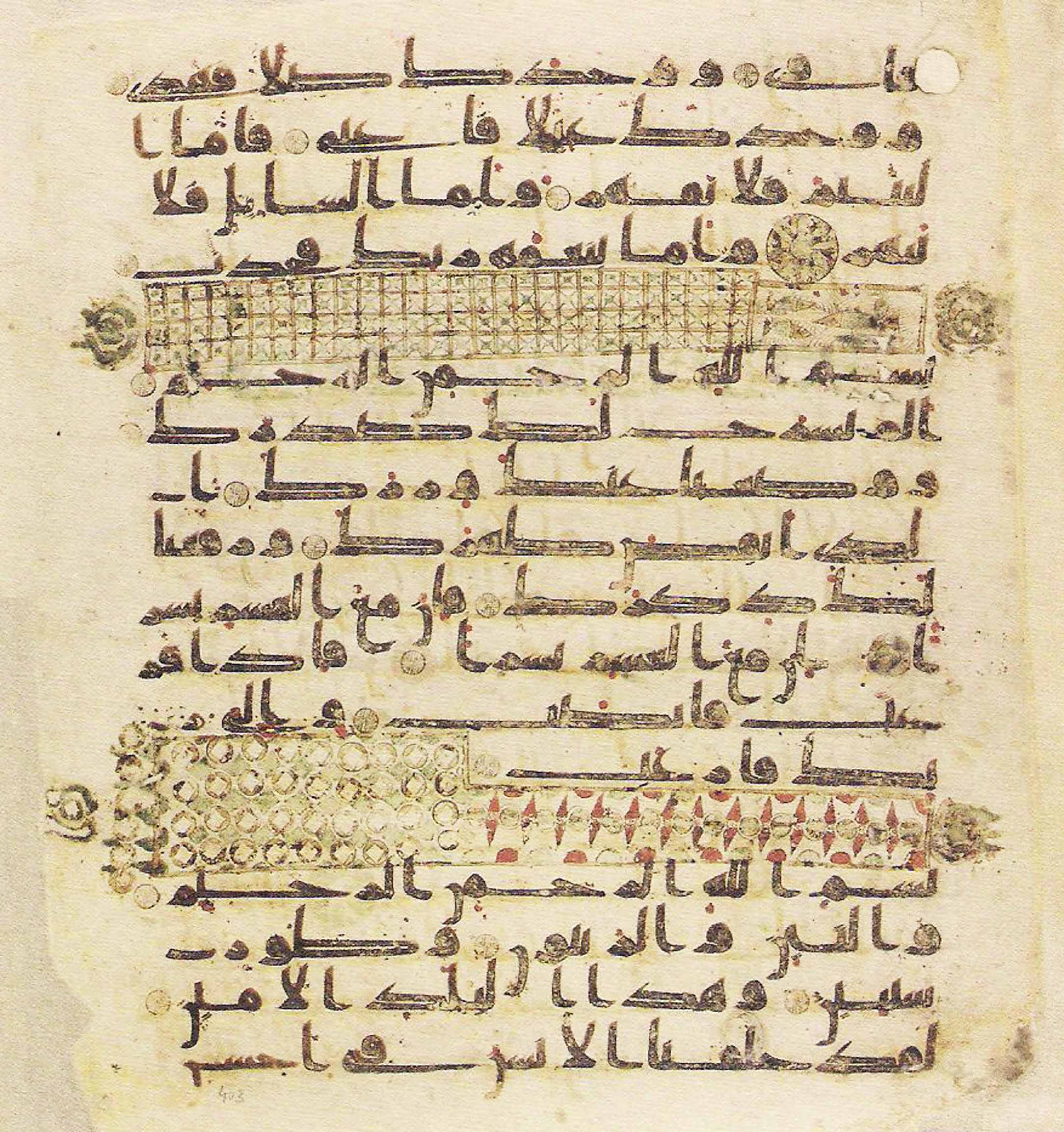
Written in Kufic script, the Topkapi manuscript is the oldest near-consummate Qur'an in existence and dates from the 8th century. (Alamy)
Written in Kufic script, the Topkapi manuscript is the oldest near-complete Qur'an in existence and dates from the 8th century. (Alamy)
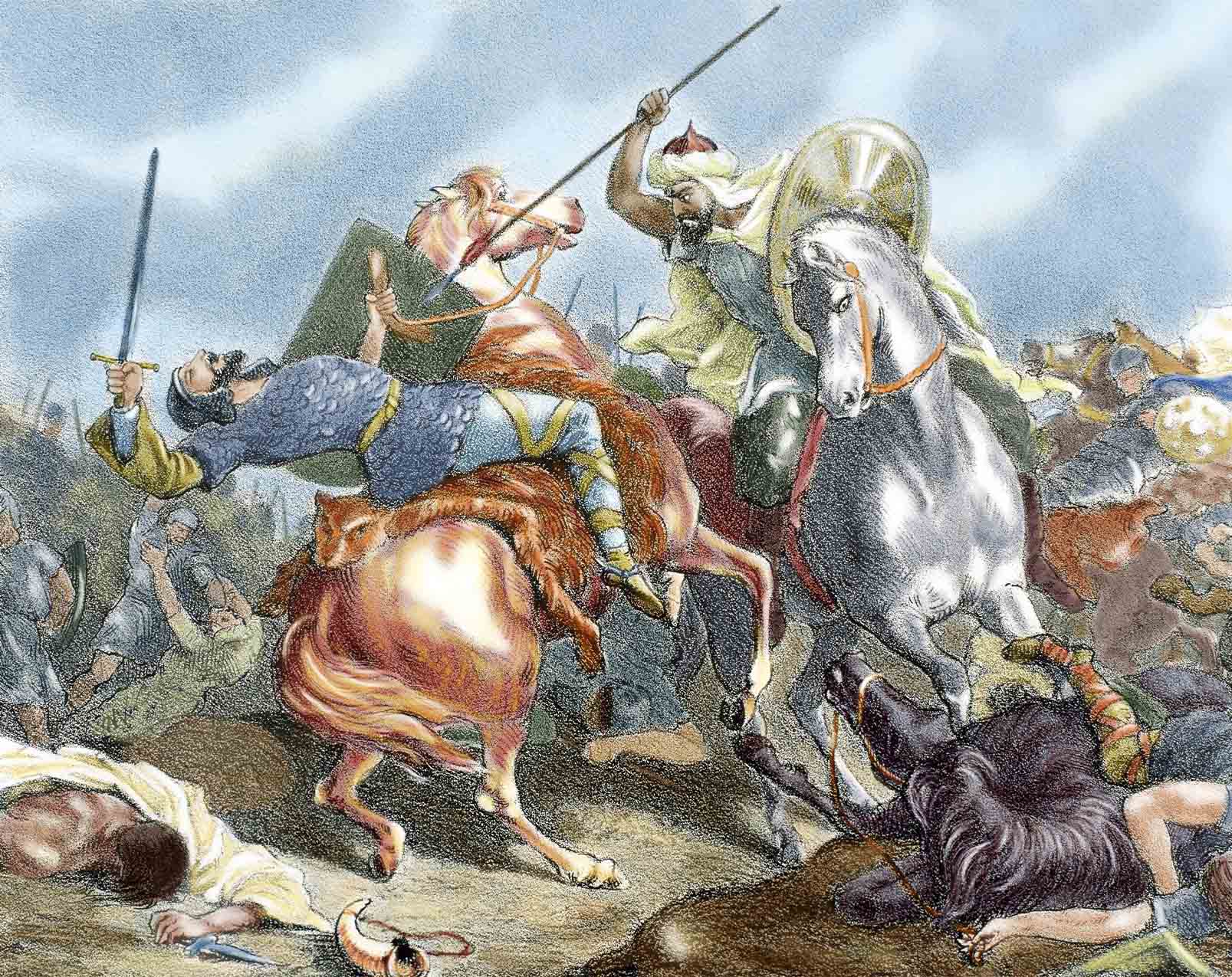
The Islamic conquests of the seventh and 8th centuries intensified the need for a script that could combine aesthetics with readability. Depicted here is the Umayyad Caliphate's conquest of the Christian Visigothic Kingdom of Hispania in 711. (Getty Images)
The Islamic conquests of the 7th and 8th centuries intensified the need for a script that could combine aesthetics with readability. Depicted hither is the Umayyad Caliphate'southward conquest of the Christian Visigothic Kingdom of Hispania in 711. (Getty Images)
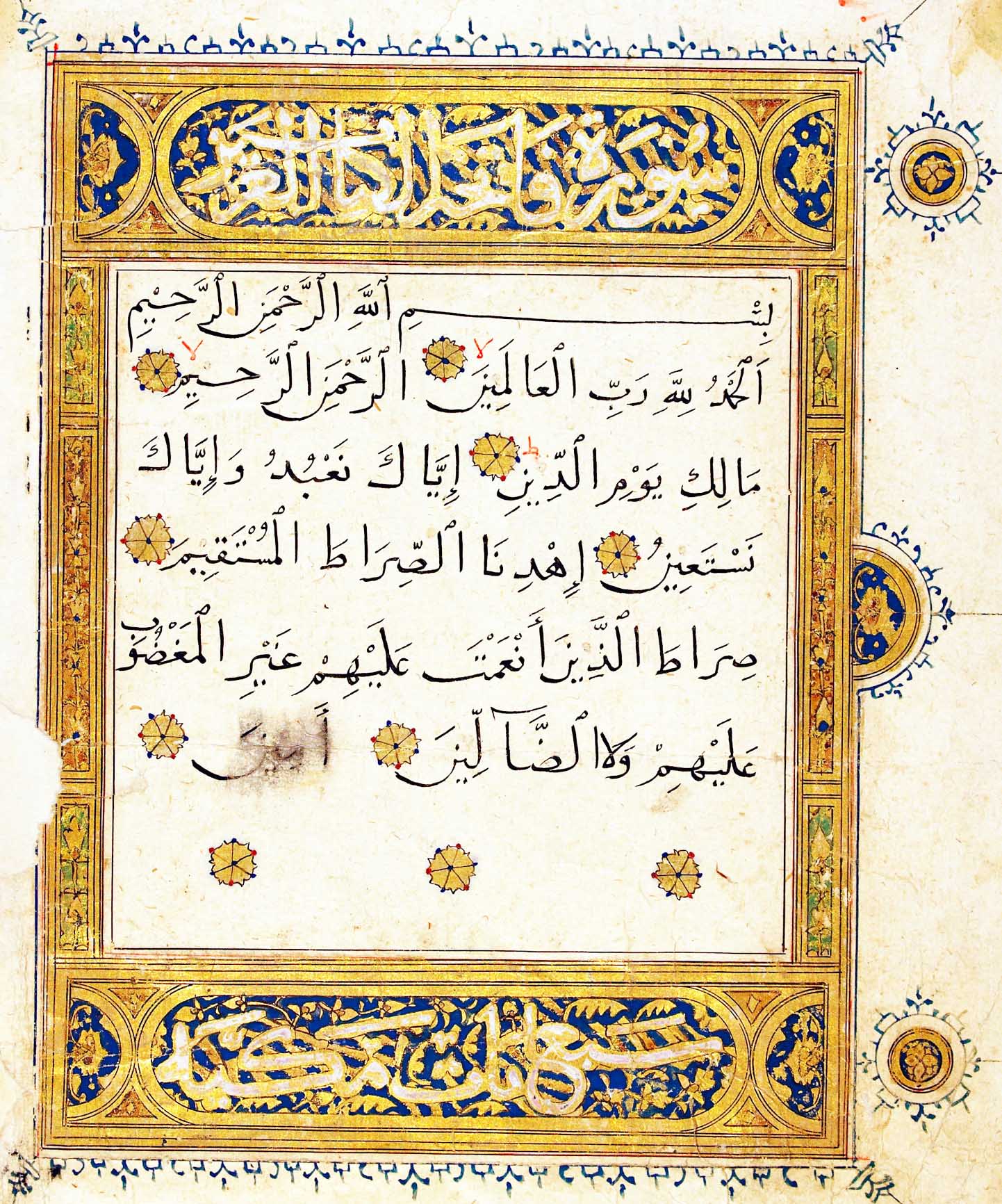
Although Kufic would remain in use until the twelfth century, its popularity waned, primarily because of the emergence of more legible cursive scripts such equally Naskh, pictured here. (Alamy)
Although Kufic would remain in utilize until the 12th century, its popularity waned, primarily considering of the emergence of more legible cursive scripts such as Naskh, pictured hither. (Alamy)
Codifying calligraphy
Although largely defined by its angularity and geometric qualities, there were no rules attached to the use of Kufic, nor was there any form of universally accepted standardization. This led to widely differing versions of the script. This lack of standardization would come to an terminate (for cursive scripts at least) with the arrival of Abu Ali Muhammad Ibn Ali Ibn Muqla — better known only as Ibn Muqla — a master calligrapher and vizier within the Abbasid Caliphate, and the first person to codify the principles of calligraphy.
Ibn Muqla's system of proportional scripts (called Al-Khatt Al-Mansub) would marking the nativity of visual consistency within the Arabic writing arrangement. Reflecting an association with the divine, the system he developed ensured the letters of any given script were in proportion with 1 another. This was accomplished by establishing the rhomboid dot (created by the nib of a calligrapher's qalam), the length of the aleph (the outset letter of the alphabet of the Arabic alphabet), and the circle (with a bore equal to the height of the aleph) as the units of measurement by which the size of all letters is calculated. This codified system was applied to six calligraphic scripts known as Al-Aqlam Al-Sitta: Naskh, Muhaqqaq, Rayhani, Thuluth, Riqa (not to be confused with Ruqʿah) and Tawqi. For example, the height of the aleph measures viii dots in Muhaqqaq, seven in Thuluth and six in Tawqi. "Y'all tin can call Ibn Muqla the engineer of writing," Al-Salem says of the celebrated calligrapher. "He collected all of this data regarding the techniques of writing. He was the i putting all of this data in one place and then that it could exist passed on from one generation to another."
Not a single line of Ibn Muqla'south work has survived, but his impact on calligraphy was profound.
Not a single line of Ibn Muqla'southward work has survived, simply his bear upon on calligraphy was profound. He brought mathematical accurateness to the reproduction of messages and heightened the aesthetics of calligraphy through geometric pattern. However, the violent nature of his demise — his right hand was cutting off and then he could non write, and when he protested with words, his tongue was cutting out also — has left an emotional scar. He somewhen died in prison in 940 CE.
"What is deep about the legacy of Ibn Muqla is his tragic life, and it affects us all emotionally as calligraphers," says the Iraqi artist and calligrapher Hassan Massoudy. "Fifty-fifty if we have not seen his work, everyone acknowledges that he delineated and reinforced simplified geometrical rules for the shape of letters. He is the only well-known effigy up until the 10th century. Amid numerous other calligraphers, he remained the most famous. This gives me hope in terms of the respect that club gave calligraphers. But nosotros are also shocked by the savagery with which he was treated in Abbasid society considering he said they had reached such levels of decadence and luxury that they no longer deserved the Kufic script, and ought to be given a softer calligraphic style."
In the years and centuries post-obit Ibn Muqla'south decease his piece of work was refined past Ibn Al-Bawwab and Yaqut Al-Musta'simi, both of whom spent the bulk of their lives in Baghdad. The former produced an estimated 64 copies of the Qur'an, the most famous of which — and the only i still in existence — is now in the Chester Beatty Library in Dublin. It is 1 of the earliest known Qur'ans to have been produced on paper rather than parchment, and one of the earliest to take been written in the Naskh script.
Ibn Al-Bawwab produced an estimated 64 copies of the Qur'an. This one, written in Naskh script, is housed at the Chester Beatty Library in Dublin. (Chester Beatty Library)
Ibn Al-Bawwab produced an estimated 64 copies of the Qur'an. This one, written in Naskh script, is housed at the Chester Beatty Library in Dublin. (Chester Beatty Library)
It was Ibn Al-Bawwab who took Ibn Muqla's system of proportional scripts and artistically elevated them through the svelte use of rhythm and move. "Despite the regularity of the letters, in that location is nothing dryly mechanical about them and that, surely, was the essence of Ibn Al-Bawwab'south stimulating contribution to the fine art of calligraphy," wrote David Tempest Rice in 1955. "He achieved a gracefully flowing script while preserving a systematized and proportioned alphabet. It looks piece of cake to imitate and withal defied simulated."
Al-Musta'simi, the last of the great medieval calligraphers, would further refine the Al-Aqlam Al-Sitta during the 13th century. Known as Sultan Al-Kuttab (Sultan of Calligraphers), he served as secretary to the last Abbasid caliph and survived the sacking of Baghdad past the Mongols in 1258. He replaced the straight-cut qalam (the calligrapher's pen) with an oblique cutting, resulting in a more refined and elegant script. Significantly, it was Al-Musta'simi who would act as the inspiration for calligraphers following the destruction of Baghdad and the bloody end of the Islamic Golden Age.
In the aftermath of the Mongols' sacking of the Abbasid capital, the center of calligraphic excellence would somewhen shift north to Istanbul. The Ottomans invented or perfected several styles, including Ruqʿah, with its straight lines and uncomplicated curves, and the intricate, heavily stylized Diwani script, developed for employ in court documents to ensure confidentiality and preclude forgery.
A 19th-century case of the intricate, heavily stylized Diwani script past Mehmet Izzet Al-Karkuki is shown here. (Alamy)
A 19th-century example of the intricate, heavily stylized Diwani script by Mehmet Izzet Al-Karkuki is shown here. (Alamy)
"It was said in the past that handwriting is emblematic of humanity itself, and when we see lines from the past, we tin also see the nature of the calligrapher conspicuously in their writings," says Massoudy. "For example, in the 15th- and 16th-century Ottoman land at that place were two great calligraphers whose work has reached us in the present solar day. The outset is Sheikh Hamdullah, whose calligraphy was full of fragile and sugariness feelings. The other is Ahmed Karahisari, who built complex letters, especially the letter 'A' (the aleph), which he drew tall like a lighthouse. A calligrapher therefore reveals himself by creating a airtight, static and rigid piece of work, simply another calligrapher tin can give the same letters new vigor, openness and vitality."
Hamdullah was foremost amongst Turkish calligraphers and is considered the father of the Ottoman school. Inspired by the work of Al-Musta'simi, he refined the six standard scripts outset codified by Ibn Muqla, perfected the Naskh and Thuluth scripts, and produced an estimated 47 copies of the Qur'an. His use of Naskh in particular turned that script into the most elegant and legible of all for transcription of the Qur'an.
An undated instance of Thuluth script. (Sharjah Museums Authority)
An undated example of Thuluth script. (Sharjah Museums Authority)
Also adult during this period was the Jali — or big — style of Thuluth and Diwani, an incredibly intricate style which can claiming even experienced calligraphers. "It has very distinctive characteristics and the more yous study it, the more y'all discover," says the Saudi-Iraqi creative person and designer Majid Alyousef. "It reminds me of fractal drawings where you see more details appearing every time you zoom in. This characteristic made information technology more interesting to study and investigate, especially when I started studying pattern and abstraction."
Advisedly studying and investigating the art of calligraphy is important to artist Majid Alyousef, whose honey of the written word began with a case of bad handwriting.
Significantly, the Ottomans categorized scripts by usage and created a system that determined which scripts would exist used for certain functions based on their class. This meant that each script's size, complexity and even harmonic proportions would make up one's mind their use. For case, the Tumar script was used for covenants, Ruqʿah was reserved for simple handwriting and correspondence, and Diwani Jali was utilized for formal short pieces such equally invitations, certificates and religious quotations.
Ruqʿah was mainly reserved for simple handwriting and correspondence. (Sharjah Museums Potency)
Ruqʿah was mainly reserved for simple handwriting and correspondence. (Sharjah Museums Potency)
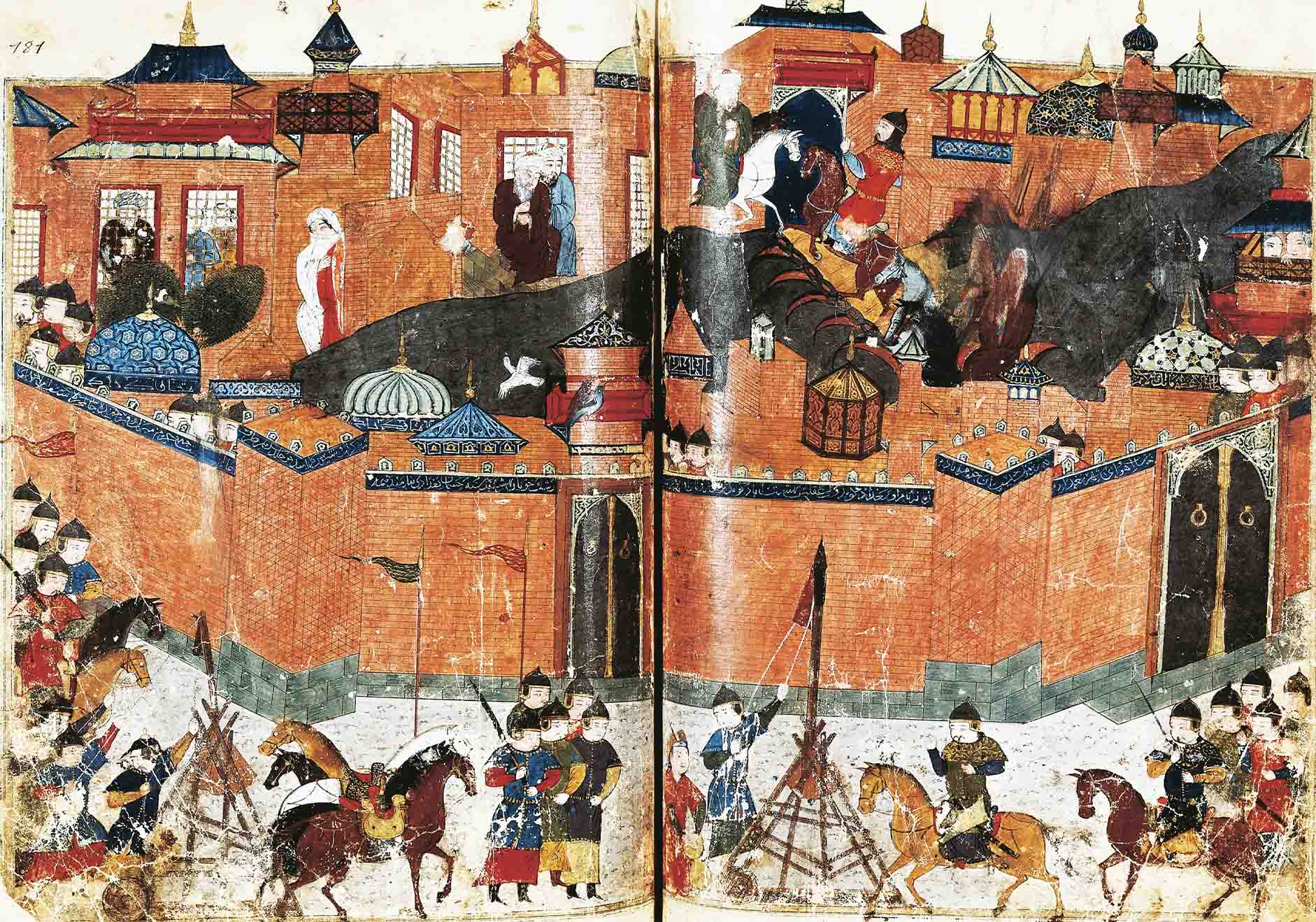
In the aftermath of the Mongols' sacking of Baghdad in 1258, depicted here, the middle of calligraphic excellence would eventually shift northward. (Getty Images)
In the aftermath of the Mongols' sacking of Baghdad in 1258, depicted here, the eye of calligraphic excellence would eventually shift due north. (Getty Images)
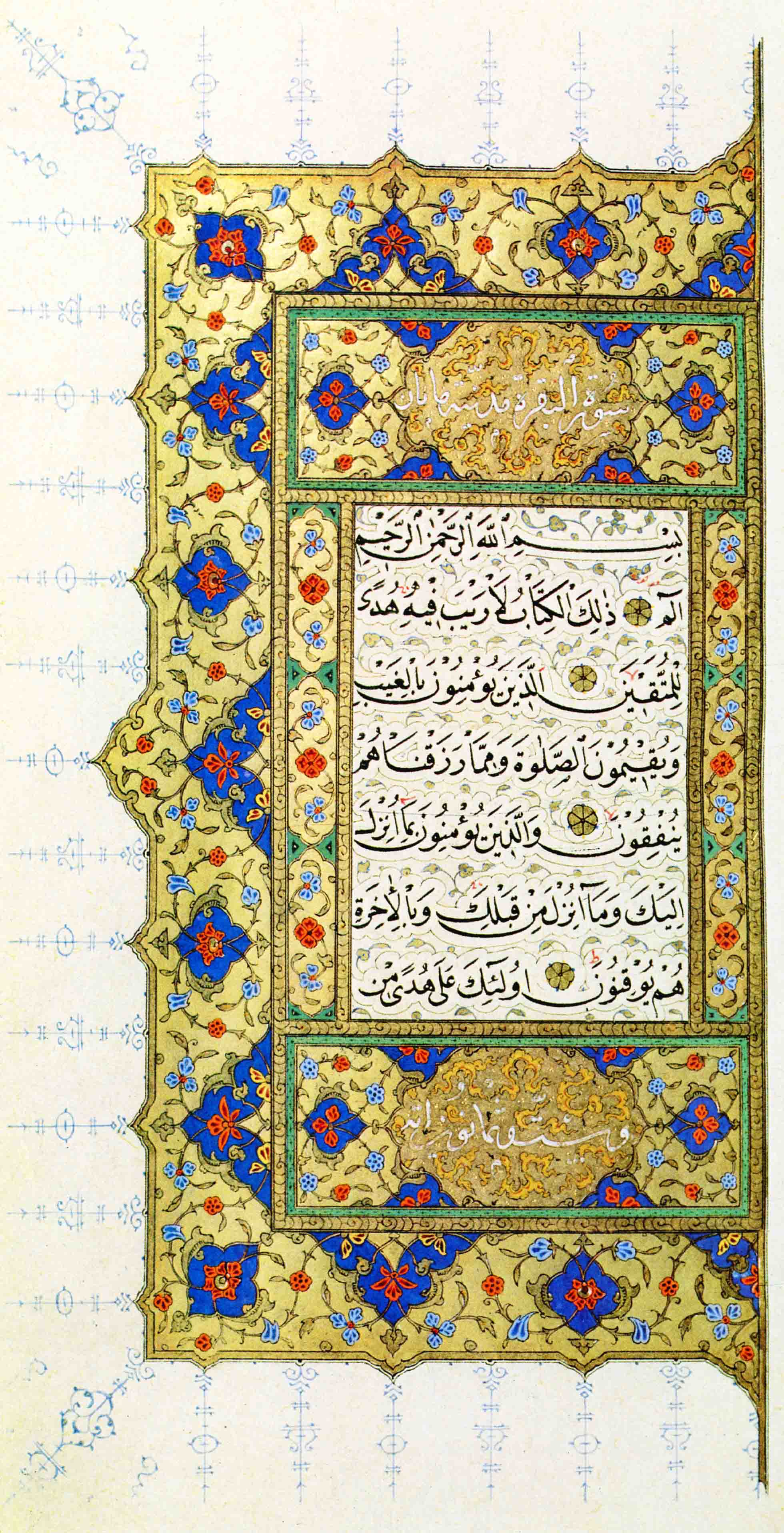
Sheikh Hamdullah, who worked between the 15th and 16th centuries, produced an estimated 47 copies of the Qur'an. (Alamy)
Sheikh Hamdullah, who worked betwixt the 15th and 16th centuries, produced an estimated 47 copies of the Qur'an. (Alamy)
Calligraphy's many uses
Although the development of Arabic calligraphy is strongly tied to the Qur'an, from the first it was used for a diversity of functions. It has adorned virtually every surface, has been embraced past a multitude of professions, and has been employed in innovative ways to create works of art based on individual letters or words. As such, it is an intrinsic part of both Arab and Islamic art.
Its most obvious manifestation — and the 1 we accept been mostly concerned with so far — has been the written word on either parchment or paper. Notwithstanding even this had multiple uses and was in no way express to Islamic texts. "Ancient bibles were also transcribed in Arabic script," notes Lana Shamma, Fine art Jameel'south senior manager of public programs. "Every bit a whole, this reverence for the written word also translated to a reverence for the Arabic language, which remains alive in nowadays-solar day culture."
The Ottomans may accept categorized scripts by form and function, only the use of any given script was always determined by its audience, its artistic form, and the content of the writing itself. Naskh, for case, was a preferred script for manuscripts and administrative documents; Rayhani was used for chancellery letters and edicts; and the highly secretive Diwani was, equally mentioned, used for court correspondence. In Persia, the Nastaliq script, which emerged during the 14th and 15th centuries, became the preferred manner for poetic texts.
This drove of Persian prose is written is Nastaliq script and hails from circa 1475-1500. (Getty Images)
This collection of Persian prose is written is Nastaliq script and hails from circa 1475-1500. (Getty Images)
Equally with many forms of expression, however, the Arabic script also "lends itself to abstraction and to the breaking of 'rules' to create singled-out styles," says Shamma. "Its flexibility also makes it appealing for applications on multiple media, ranging from architecture to book illumination to embroidery on textiles." As such, Arabic calligraphy can be found on everything from ceramics, textiles and enameled glass to coins, metalwork, carpets and woodcarvings.
Styles of floriated Kufic were developed to adorn ceramics in the Fatimid era; inscribed textiles known as tiraz were embroidered with the names of Caliphs and bestowed every bit gifts; and mirrors cast in bronze were engraved with good wishes. Calligraphers would often create works of exquisite dazzler and sometimes staggering complexity, exploiting Arabic'southward versatility and its potential as an ornamental class.
This 12th-century mirror bandage in bronze features foliated Kufic good wishes on the outer rim. (Alamy)
This 12th-century mirror cast in bronze features foliated Kufic adept wishes on the outer rim. (Alamy)
Certain scripts — specially Kufic and Thuluth — also lent themselves to compages. Calligraphic inscriptions adorn a variety of religious, military and civic buildings and, in many cases, were monumental in stature. As mentioned previously, one of the earliest known examples of architectural inscription tin be found in Jerusalem's Dome of the Rock, but inscriptions are prevalent within buildings across the Islamic world. They beautify the Sultan Hassan Mosque in Cairo, i of the finest examples of early Mamluk architecture; the Bou Inania Madrasa in Meknes, Morocco; and the Shah Mosque in Isfahan, considered a masterpiece of Persian architecture.
Calligraphy adorns the Sultan Hassan Mosque in Cairo, 1 of the finest examples of early on Mamluk compages. (Shutterstock)
Calligraphy adorns the Sultan Hassan Mosque in Cairo, one of the finest examples of early Mamluk architecture. (Shutterstock)
AUC's Shehab believes calligraphy had three main architectural roles: "The offset ane was informative, because buildings normally stated who the patron was, when the building was synthetic, and the name of the edifice. If there was a waqf (a charitable endowment) for the building it was as well either engraved or painted inside the building.
"The second 1 was decorative. Because zoomorphic and human representations were not accepted in religious spaces, calligraphy and geometric motifs, which we call Arabesque, were key to decorating internal spaces," she continues.
"And I call up the third idea is a manifestation of power. When you have these large, beautiful scribed paintings in a mosque in Turkey, or on a facade in Mamluk Egypt, or on a Safavid building in Iran or in Mughal India, this cute calligraphy is a manifestation of piety but likewise of ability — of respect for God. Because when you stand in front of something then beautiful y'all are in awe."
This beautiful calligraphy is a manifestation of piety only also of power — of respect for God.
In the Bibi-Khanym Mosque in Samarkand and the Mausoleum of Qalawun in Cairo, it is the bricks and tiles that course the text using geometric Foursquare Kufic. Referred to as Banna'i in Western farsi, this fashion of decorative brickwork may take originated in Syrian arab republic and Iraq just arguably found its greatest expression in Iran and Key Asia. In the Mausoleum of Khoja Ahmed Yasawi in Kazakhstan, for example, blue brickwork spells out the names of Allah and of the Prophet Muhammad, while raised brickwork in both Kufic and Naskh can be found on the Minaret of Saveh in Iran.
Calligraphers were likewise at the heart of the age of discovery encouraged by the Abbasid caliphs of Baghdad. Astronomers, physicians, mathematicians and cartographers may accept expanded Arab and Muslim noesis, interim equally a bridge of learning between Ancient Greece and the European Renaissance, but it was calligraphers who helped tape that knowledge. Calligraphers such as the tenth-century bibliographer Ibn Al-Nadim, whose "Kitab Al-Fihrist" is an index of all the books written in Arabic at the time of its publication. Hence calligraphers played a role in "preserving man knowledge and history," says Alyousef, just as calligraphy itself acted as a "symbol of uniqueness and a signature of identity." Something that it continues to do today.
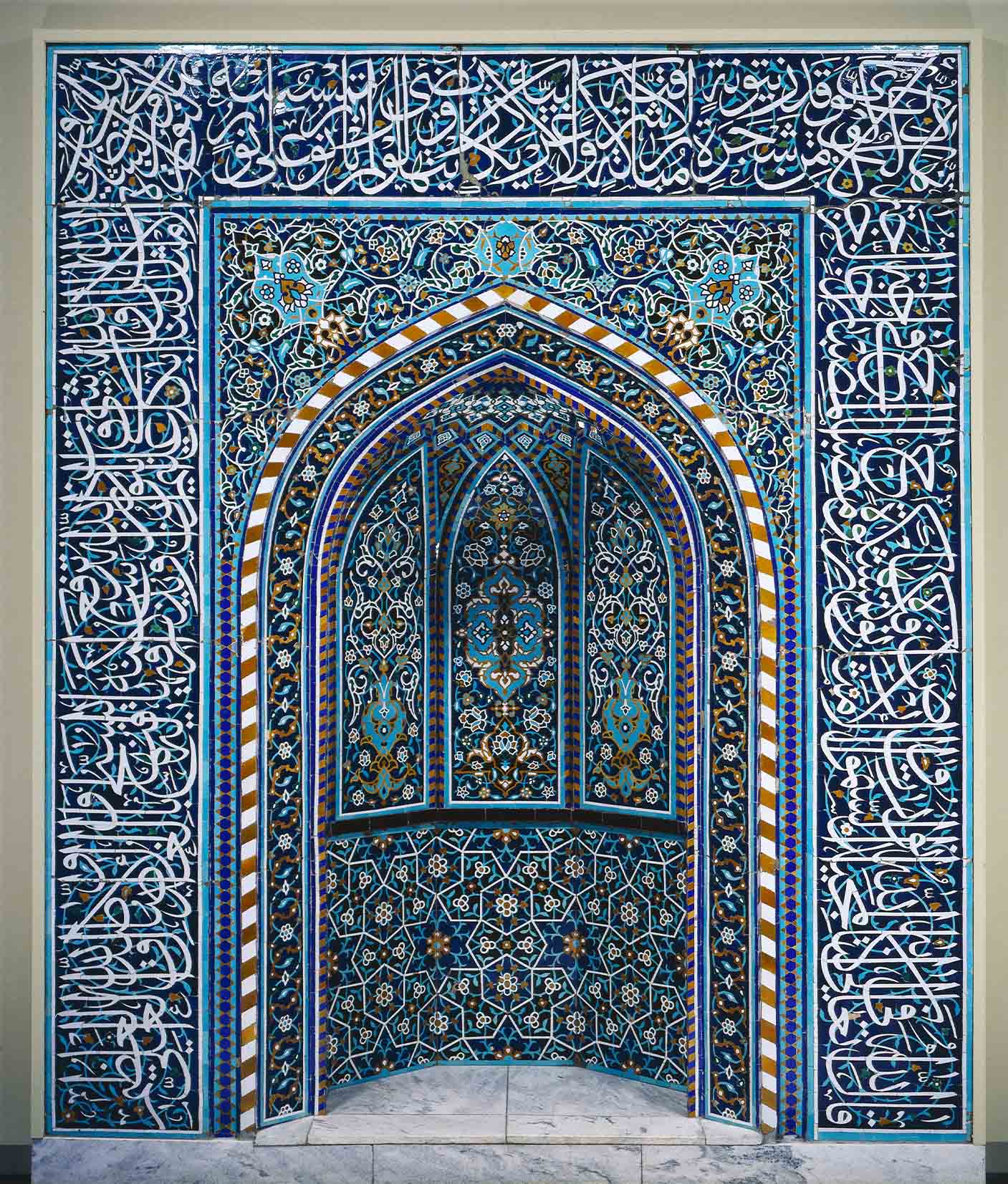
Aside from paper and parchment, Standard arabic calligraphy can be plant on ceramics, pictured here, textiles, metalwork, carpets and more. (Shutterstock)
Aside from paper and parchment, Arabic calligraphy can exist establish on ceramics, pictured here, textiles, metalwork, carpets and more than. (Shutterstock)
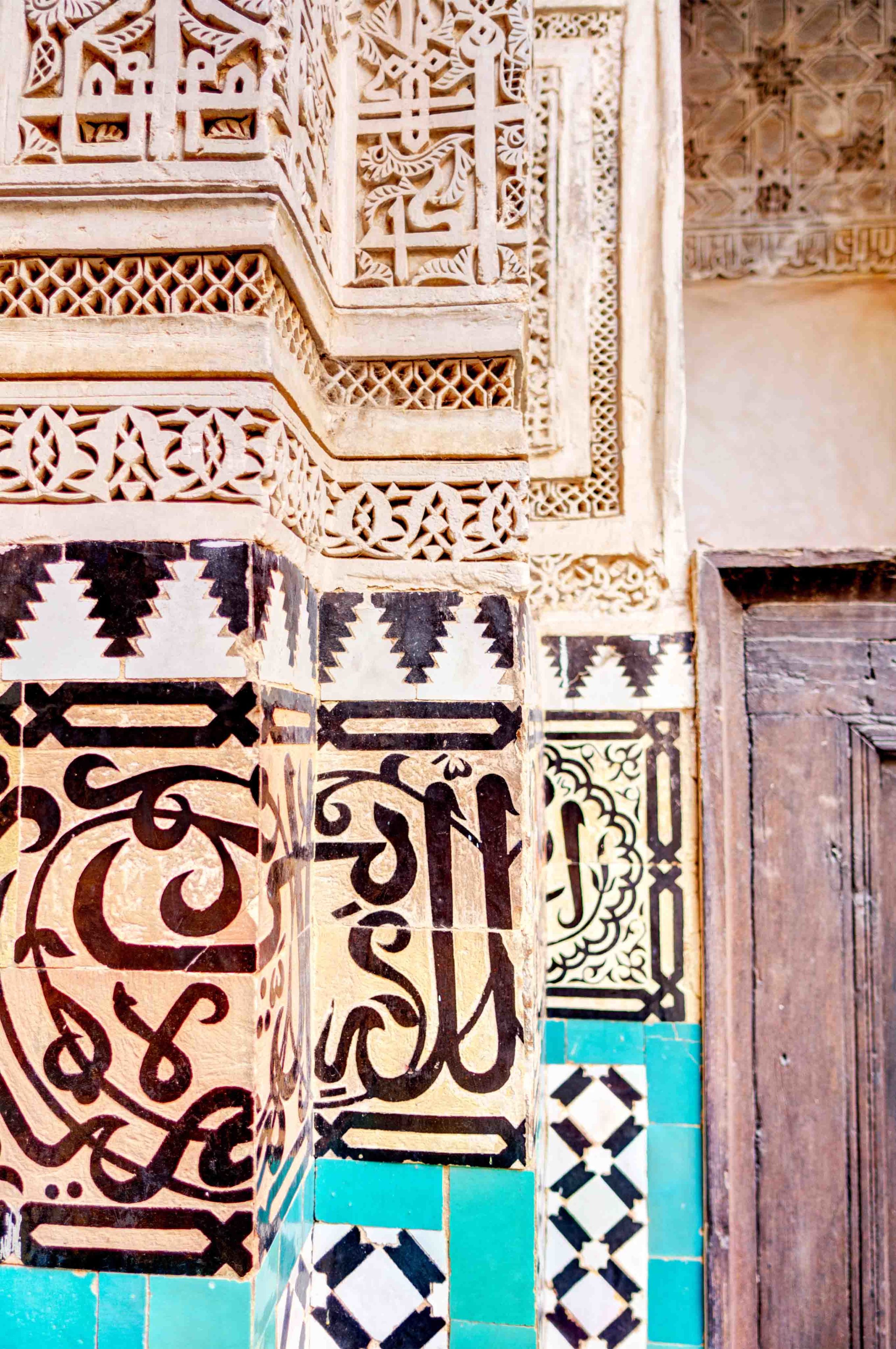
A close upwardly of the calligraphy-adorned walls in the Bou Inania Madrasa in Meknes, Morocco. (Shutterstock)
A close upwards of the calligraphy-adorned walls in the Bou Inania Madrasa in Meknes, Morocco. (Shutterstock)
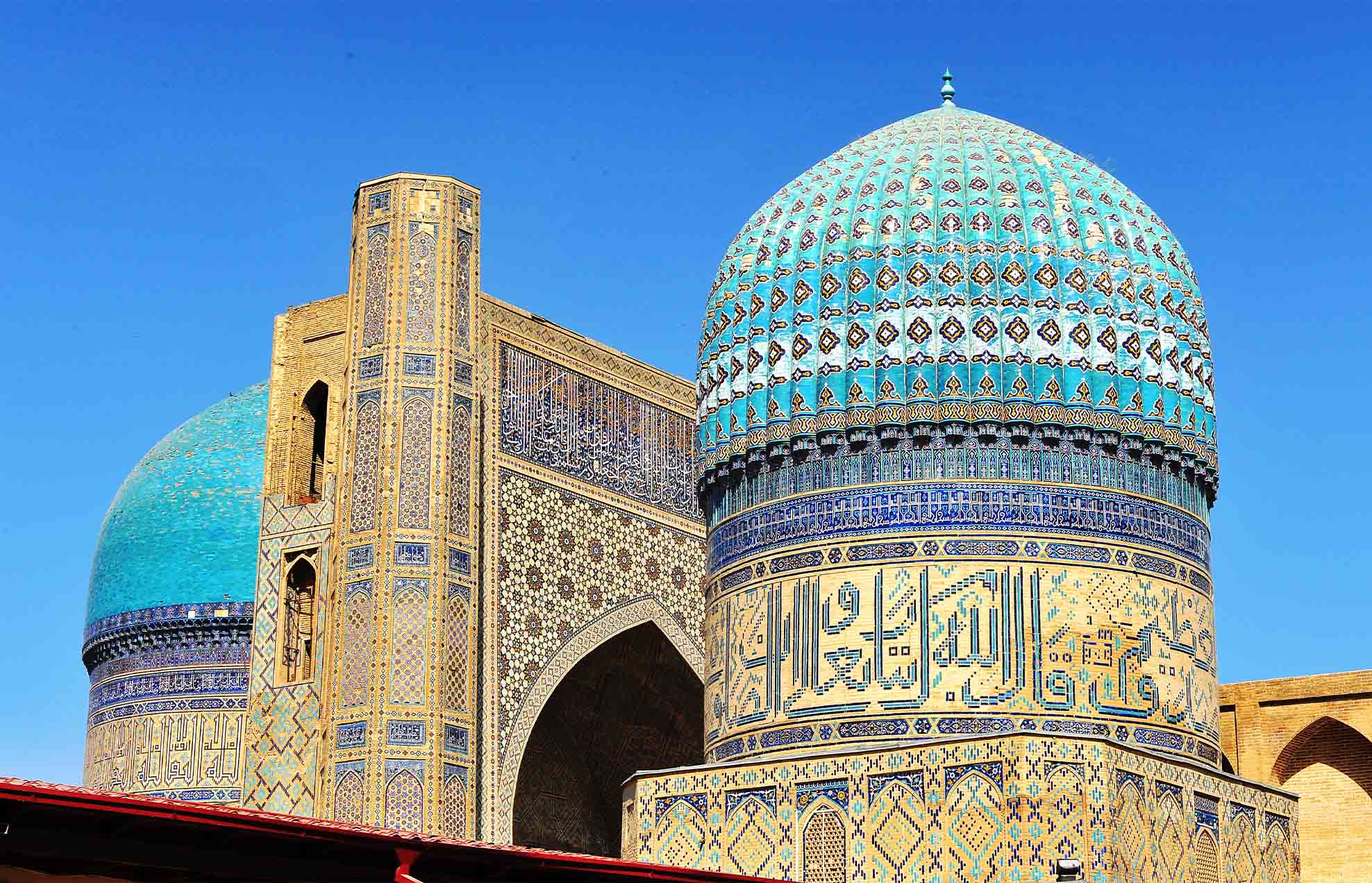
In the Bibi-Khanym Mosque in Samarkand, it is the bricks and tiles that form the text using geometric Kufic. (Shutterstock)
In the Bibi-Khanym Mosque in Samarkand, it is the bricks and tiles that form the text using geometric Kufic. (Shutterstock)
A calligrapher'south
toolkit
"I've been doing calligraphy for 35 years and I'chiliad nevertheless practicing," says Shawkat. "I practice daily. It'southward like music. The more you practice, the more your messages mature."
Artist Wissam Shawkat explains why he believes artists should constantly innovate.
As with all forms of fine art, calligraphy is as much about patience, practice and passion as it is about inherent skill. That ways years spent with pen, ink and paper, mastering an art class that is cherished for its beauty, clarity and harmony. Traditionally, that would have meant existence taught by a master calligrapher, who would have ready at least i day aside each week to correct students' calligraphic studies. This tradition continues today, although the early on 20th century saw the establishment of calligraphy schools including the Madrasat Tahsin Al-Khotoout, the Khalil Agha School in Cairo, the Medresetul Hattatin in Istanbul and the Dar Al-Qalam Complex in Madinah.
Nosotros visit the Dar Al-Qalam Complex in Madinah to find out more about how students are embracing the fine art of calligraphy.
One former attendee of the Madrasat Tahsin Al-Khotoout was Massoudy, who spent a curt period of time at that place in 1980. "The encounters betwixt great calligraphers and amateurs made my fourth dimension there experience longer than it was," he recalls. "I had a similar feeling when I went to the capital of Ottoman calligraphy, Istanbul. I met the terminal great Ottoman calligraphers, such equally Hamid Aytaç, who created calligraphy for me that I cherish. Despite spending less than a calendar month on that trip, information technology felt as if I had been studying and learning there for many years. Truth be told, I had hundreds of questions that I had not found answers for. And my trip to Turkey gave me the answers to nearly of them."
For virtually modern calligraphers their first introduction to the art of calligraphy was at primary schoolhouse. It was there that the Lebanese artist and poet Samir Sayegh first used 'forbidden' ink and was praised for the beauty of his handwriting. Information technology was at school in Najaf that Massoudy, also, was applauded for his calligraphy, before moving to Baghdad every bit an amateur and spending his days "practicing from morning until nighttime."
"Sometimes I'd have a coming together or encounter that broadened time," he remembers. "An hr with the calligrapher Hashem Al-Baghdadi (considered the last of the classical calligraphers) felt similar a full yr to me. On a day when he would depict words for me I would feel that I had grown bigger."
Al-Salem describes the rigorous training and dedication it takes to even begin to master the art form: "I studied calligraphy near the Holy Mosque in Makkah. I had a calligraphy mentor and instructor and I studied during summertime holiday and three times a calendar week… I would go after Fajr prayer and spend all day at that place studying and learning — I was 13 years old," he says.
He, like the majority of calligraphers, relies on essential tools that have non changed much throughout history — the reed pen (qalam), a selection of knives (for cutting the reed or bamboo), various inks (traditionally made of soot dissolved in water and Arabic glue), and the parchment or paper on which to write.
Reed pens were chosen because they combined hardness and softness, solidity and flexibility, and allowed for an easy flow of ink to the surface of the paper. Various accessories, such every bit pen boxes and inkwells, would adorn a calligrapher's desk-bound, while calligraphy carried out on other materials, such as metal or woods, would require a option of carving tools.
In traditional calligraphy books, tens of pages depict the reed pen and the manner in which it is cut, slit, dried and preserved.
"In traditional calligraphy books, tens of pages describe the reed pen and the manner in which it is cutting, slit, dried and preserved," says Sayegh, whose Beirut studio is filled with inkwells, pliers, end cutters, a hacksaw, two wooden mallets and an old hand-operated drill. "Tens of pages, too, describe the pocketknife that the calligrapher should use in making the reed. Many other pages describe inks and how to produce and prepare them."
In the "Subh Al-A'sha," an encyclopedia written by the Egyptian polymath Al-Qalqashandi in the early on years of the 15th century, there are hundreds of pages on pens, knives, inks and other technical issues that the calligrapher needs to exercise in gild to primary the art of calligraphy. The nib of the reed pen, for instance, should be cut at an inclined angle and and then slit in the middle to facilitate the flow of ink. The angle of the inclined cutting depends on the intended script, while the blazon of reed used is largely downward to personal preference.
"Cutting the pen at an inclined angle brings together both sides of the pen, thus helping the hand in smoothing its rotation with the pen and enabling the calligrapher to unite betwixt two parallel lines," explains Sayegh. "The inclination helps to brand i side of the pen like a dot where the left and right sides meet every fourth dimension the alphabetic character reaches its terminate or meets some other letter. This blueprint is one of the secrets of the art of calligraphy and makes information technology a witness to the hidden lodge of the universe."
Although the pens used by calligraphers evolved over time — particularly following the evolution of scripts such every bit Diwani, Diwani Jali and Ruqʿah — they were essentially variations on the original qalam. "It is interesting to note that this development was the result of the prevalence of the commonsensical side of calligraphy over its aesthetic side," adds Sayegh. "Pens that prioritized writing and conveying the linguistic content did not seek more creativity equally much equally they sought solutions that balance beauty and utility, such as the Naskh, Taliq and Ruqʿah scripts."
The same pens are nonetheless in use today. Shawkat uses traditional styles such as the Khamish, Handam and Java, as well equally mod pens such equally the Tomar, which is made from a large piece of bamboo or wood. He likewise uses Pilot Parallels that have been modified for the Arabic language and different brands of fountain pen with modded nibs, such as Pelikan and Osmiroid. Sayegh, whose art is based on individual letters or words, has seen the pens he uses abound in size, notwithstanding the essence of their pattern has been preserved.
The newspaper used today tends to be handmade in countries including Nepal, India and Japan, but early calligraphers wrote on parchment made of sheep or deer peel. Such parchment was used for writing letters, official documents and religious texts and connected to be produced until the 11th century. The arrival of newspaper from China in the 8th century, nonetheless, led to the creation of the first paper factories in Samarkand and eventually to the production of paper in Baghdad, Damascus and Cairo.
However, paper posed 2 problems for calligraphers. Firstly, information technology was absorptive. Secondly, it tended to be rougher than parchment and was not smooth enough to let the pen and the ink to flow well. These problems were overcome with the awarding of coatings, which gave the paper a glossier finish once dry. Such paper is oft called Ahar, or Muqahar.
"For the calligrapher, newspaper has to carelessness its own presence in gild to reveal calligraphy's full appearance," says Sayegh. "Paper in relation to calligraphy is similar a mirror in relation to the face up — the cleaner and the more neutral it is, the clearer the face appears. Paper has to withdraw in order for calligraphy to fill the place.
"Nosotros strive today to understand the meaning of absenteeism, withdrawal, cleanliness, neutrality and clarity," he adds. "And according to our dissimilar agreement of the terms and our different intentions of utilize, materials that will carry the calligraphy will also change."
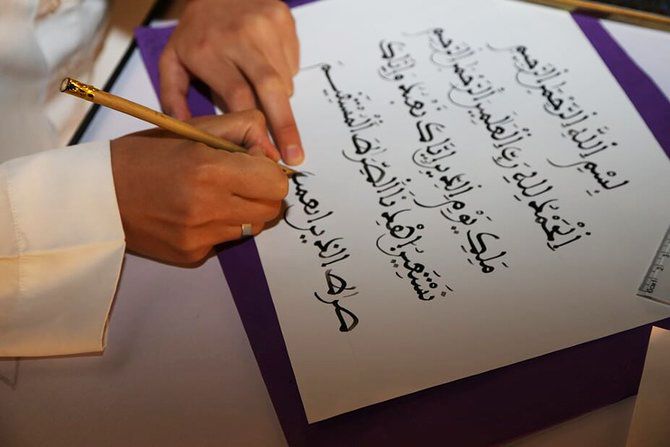
A pupil practices calligraphy using a traditional reed pen at the Dar Al-Qalam Circuitous in Saudi arabia. (Arab News)
A student practices calligraphy using a traditional reed pen at the Dar Al-Qalam Complex in Saudi Arabia. (Arab News)
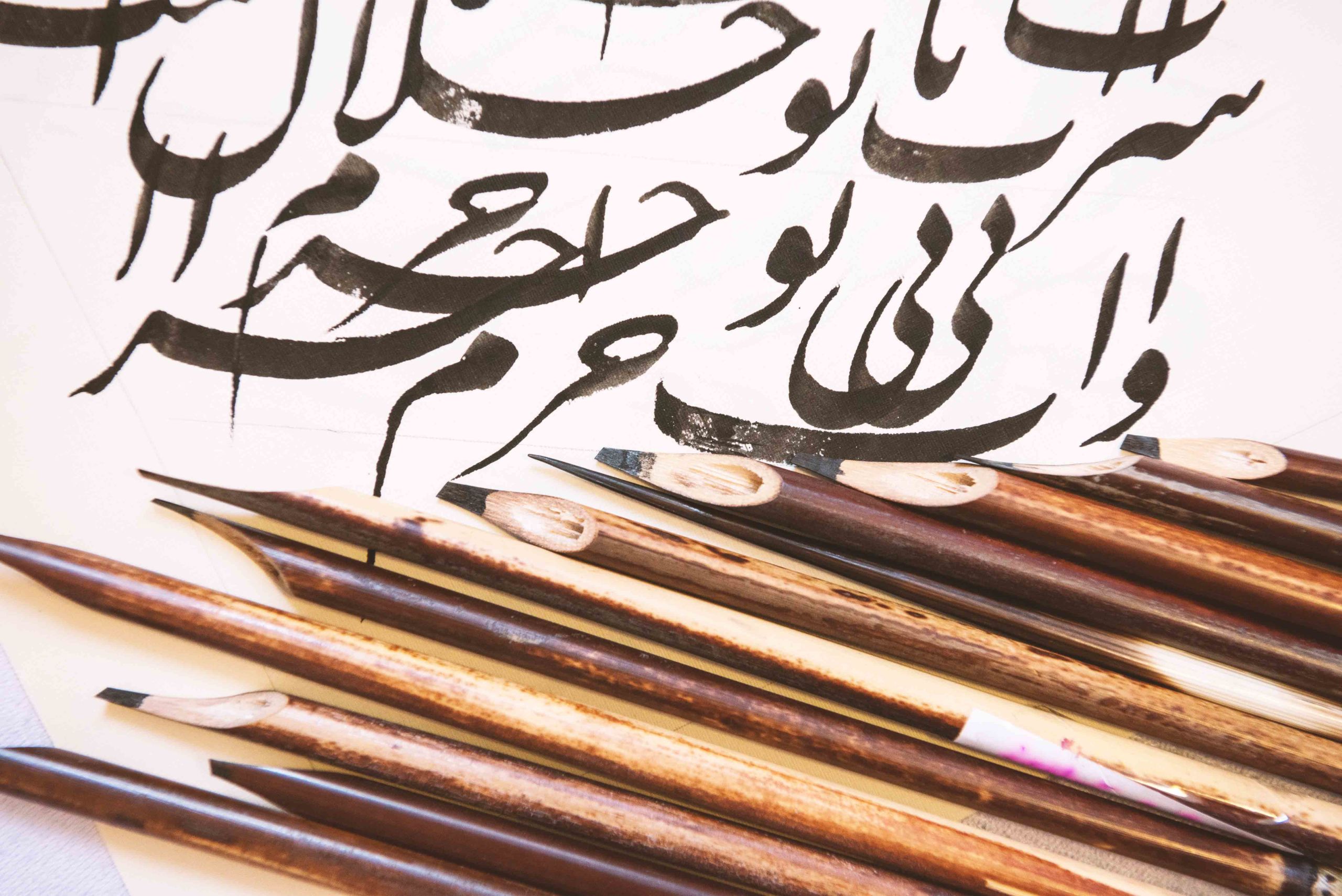
Reed pens combine hardness and softness, solidity and flexibility. (Shutterstock)
Reed pens combine hardness and softness, solidity and flexibility. (Shutterstock)
Turning the page
Any give-and-take of calligraphy's part in the modern world cannot be limited to calligraphy itself. It must comprehend the entirety of its legacy, from art and typography to design and branding.
Every bit Shamma says, calligraphy is the foundation of typography, which has had a profound touch on the development of graphic design. "This is apparent in the fashion typography has evolved as an fine art grade in itself," she says. "You lot also see Arabic calligraphy transcending pen and paper in the grade of calligraffiti, with artists such equally eL Seed combining street art with calligraphy and roofing building facades to highlight architecture and often times unite communities around the messages depicted."
French-Tunisian artist eL Seed merges a variety of influences. Here, he talks to us nearly his groundbreaking arroyo from his studio in Dubai.
Some other instance is the intricate work of Saudi artist Lulwah Al-Homoud, who incorporates Standard arabic letters to create complex abstract works on paper, synthesizing feature motifs from Islam with the rhythms found in calligraphy and geometry to transform them into a new visual vocabulary, thereby breaking the mold in her own way.
Born in 1967 in Riyadh, Al-Homoud now lives and works between Dubai and London and seeks to comprise calligraphy in her abstract work in a manner that departs from the fine art course's original use. "The manner I use my compositions of messages and words is anarchistic," she says. "The mode I apply calligraphy is not meant to exist read. It will inquire people to look more deeply into the painting to exist able to effigy out what is written. It is not direct. There'southward a visual ambiguity to my work. I deconstruct the words in my work and then rebuild them."
Saudi artist Lulwah Al-Homoud incorporates Arabic messages to create complex abstract works and spoke to us about her creative process.
Even so the trend toward a realignment around fine art and pattern, combined with the predominance of printing and the digitization of the Standard arabic script, has had a considerable affect on traditional calligraphy. In Egypt, a country all the same considered to be a calligraphic hub, institutes such as the Khalil Agha School are struggling to survive following the removal of state funding, while calligraphy's popularity across the wider Arab earth has declined. Both the Madrasat Tahsin Al-Khotoout in Cairo and the Medresetul Hattatin in Istanbul have long since closed. In plow, the demand for calligraphers has itself diminished. "Information technology is said that in the 19th century there were around 1,500 calligraphers in Istanbul," says Massoudy. "And when the press press was introduced they protested with a coffin that had their pens in it."
"The traditional practice of calligraphy has suffered from a refuse since the invention of the printing press," adds Alyousef, who works in the fields of creative design, typography and calligraphy. "As time goes by and technology advances, the need for a calligrapher who writes books is extremely rare. But the rich heritage and aesthetic values of calligraphy brand it very valuable in abstruse art, architecture, pattern and other similar fields. That's why I retrieve the best way to continue and even accelerate the instruction of calligraphy comes through a deeper study of design, course and abstraction."
In Arabic typography, designers are creating groundbreaking work inspired past calligraphic forms to create fonts that reflect the world we live in. In doing so, they are finding "solutions to issues of legibility and aesthetics and creating fonts that are truly unique, proportionate and functional," says Basma Hamdy, an Egyptian designer, educator and the writer of "Khatt: Egypt'due south Calligraphic Landscape."
In the realm of art, Sayegh has ignored the calligraphic rules established by Ibn Muqla, stylizing both the geometric and cursive variations of Arabic calligraphy to create a universally observable practice based on form and beauty. For his geometric work, that has meant a focus on equilibrium and a dialogue between line and space. For the more free-flowing pieces, it has meant a system based on motion and balance. He has concentrated on freeing calligraphy from the constraints of language.
Massoudy, too, has taken individual letters, words and phrases and created vibrant works of fine art that, despite their interruption with tradition, go along to express the beauty of Standard arabic calligraphy. Both artists are considered to be part of the movement known equally "Hurufiyya," which combines tradition with modernity to create a culturally specific visual linguistic communication.
The desire to bring calligraphy into the modern age is echoed by Saudi artist Al-Salem, who "began questioning how I could make my calligraphy become a contemporary art form."
Al-Salem is known for his recontextualization of calligraphy in mixed-media formats. He uses neon tube lights, concrete blocks and laser-cutting stainless steel to create new forms of calligraphy that defy convention.
"I began as a classical calligrapher," he explains. Merely having traveled abroad, he says he realized "I wanted information technology to co-exist within the realm of contemporary fine art. I was request myself the question that almost calligraphers today inquire themselves: How can we evolve from such an ancient and traditional art form?"
Saudi artist Nasser Al-Salem speaks to us about his approach to the art of the written word, particularly his dearest of mixed media formats.
In their ain way, street artists such every bit eL Seed and Yazan Halwani, who merge Arabic calligraphy with graffiti art, have also helped to breath new and visually intriguing life into scripts such every bit Kufic, Diwani and Thuluth. Halwani in particular, with his focus on cultural icons and the writings of poets including Mahmoud Darwish, has contributed towards the Standard arabic script's connected function every bit an integral function of Arab and Islamic identity.
"As long as Arabic is a spoken linguistic communication, Arabic text continues to be the visual language that accompanies it," says Art Jameel's Shamma. "The awarding of calligraphy in innovative ways using different media and conceptual research is evidence of its influence in current practices."
Shamma cites the Iraqi artist Mehdi Moutashar, who used Arabic script every bit the inspiration for his work "Two Folds at 120 Degrees," and Shehab's "A Thousand Times No," which featured 1,000 different versions of the word 'la.' The latter was starting time exhibited on a plexiglass curtain measuring three.5m by 7m in 2010. Shehab also compiled her research into a volume, which placed each depiction of the word 'la' chronologically, stating the place she had plant it, the medium used, and the patron who had deputed the work. "I'm inspired past history to comment on the current situation," she says. "For me, calligraphy is a manifestation of identity."
Shehab has also founded Type Lab inside AUC to document the varying forms of Arabic lettering. So far the lab has documented almost 70,000, with the goal of helping designers create solutions for the future. "The future lies with the youth who are supposed to design a new Arab identity," she says. "Once they sympathise their history they will be able to blueprint their future."
Not everyone has embraced this brave new world. Many traditionalists believe that proportion and form in calligraphy should be adhered to, not discarded with nonchalance. And while many believe there is room for modernization and the evolution of new scripts, others defend classical tradition. Others question whether movements such as calligraffiti, which has no rules and requires no formal training, should even be talked about in the same breath as calligraphy.
"I say to those who reject to look at new currents and new methods in Arabic calligraphy: If we had practical such an thought to calligraphy for the previous ane,000 years, we would still only exist using Kufic," says Massoudy. "What we see today are the styles that take been created by innovators from every era. Perchance, in their time, these innovative new methods of calligraphy were met with like doubts. Still, these styles accept become part of our history and have been placed in glass boxes and kept in safe places such every bit museums, where nosotros preserve them as we preserve everything that is morally and materially valuable. Therefore, every rejection of artistic or literary product is nothing only a contribution to the impoverishment of order."
What we come across today are the styles that accept been created past innovators from every era.
None of which means traditional Arabic calligraphy is in concluding decline. Far from it, in fact. Spurred on by exhibitions, workshops, talks and prizes, particularly in the UAE and Saudi arabia, it is once over again being celebrated in all its forms. Nowhere more so than in the Saudi Ministry of Culture's Year of Arabic Calligraphy.
"At that place is a big place for calligraphy in our modern world. With ever-evolving technologies, I see a future world where calligraphy and the formal beauty of the script become an of import, if not a necessary, component of our everyday experiences. I believe we adapt to what nosotros are served or presented with," says Hamdy. "Why tin can't nosotros imagine a world where calligraphic dazzler becomes a necessity for communication? Where wonder is embedded in the simplest acts of reading and deciphering?"
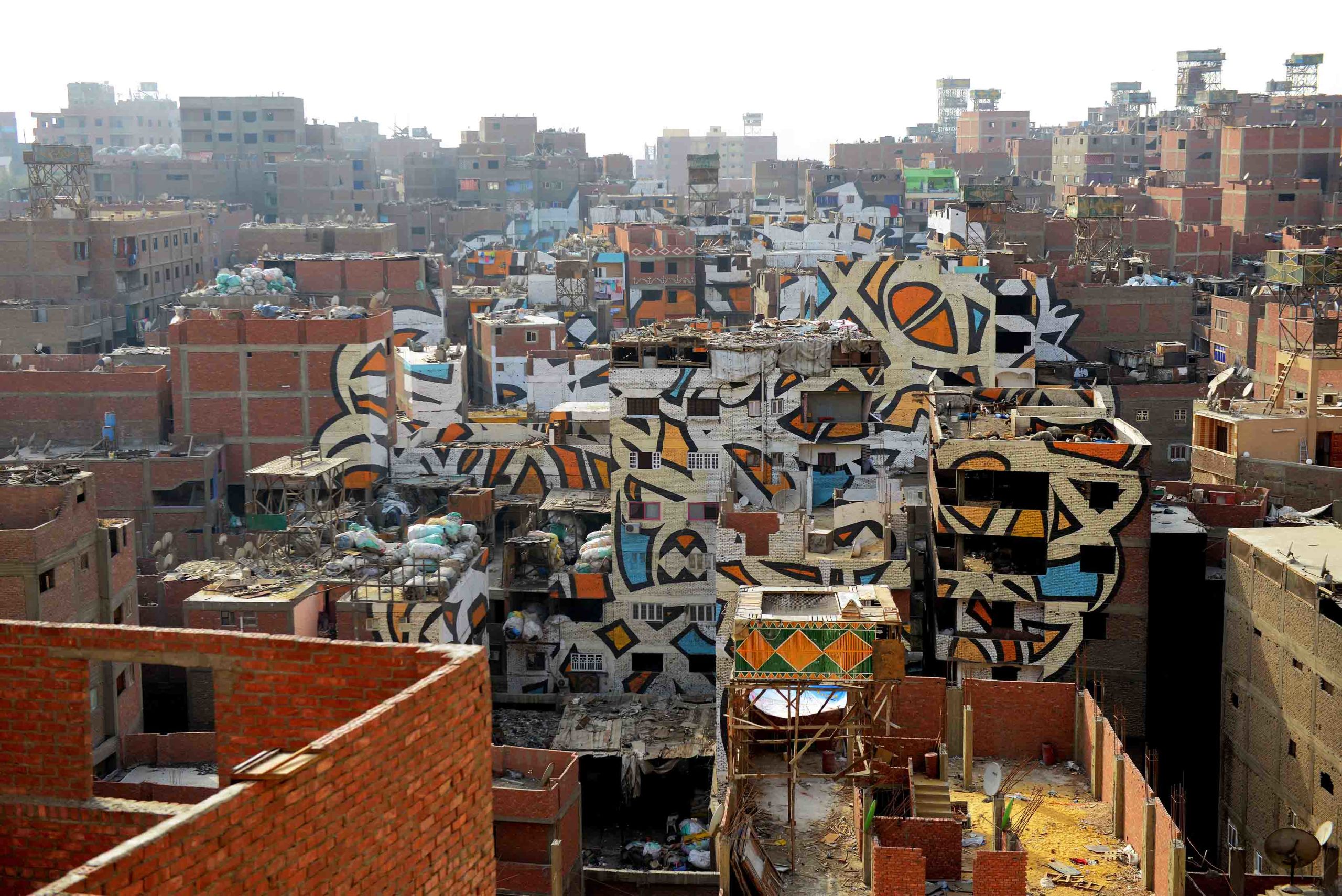
French-Tunisian artist eL Seed is office of a new wave of calligraphy-focused artists. He has created works across the world, including 'Perception' in Cairo, pictured hither. (Supplied)
French-Tunisian artist eL Seed is part of a new moving ridge of calligraphy-focused artists. He has created works across the world, including 'Perception' in Cairo, pictured here. (Supplied)
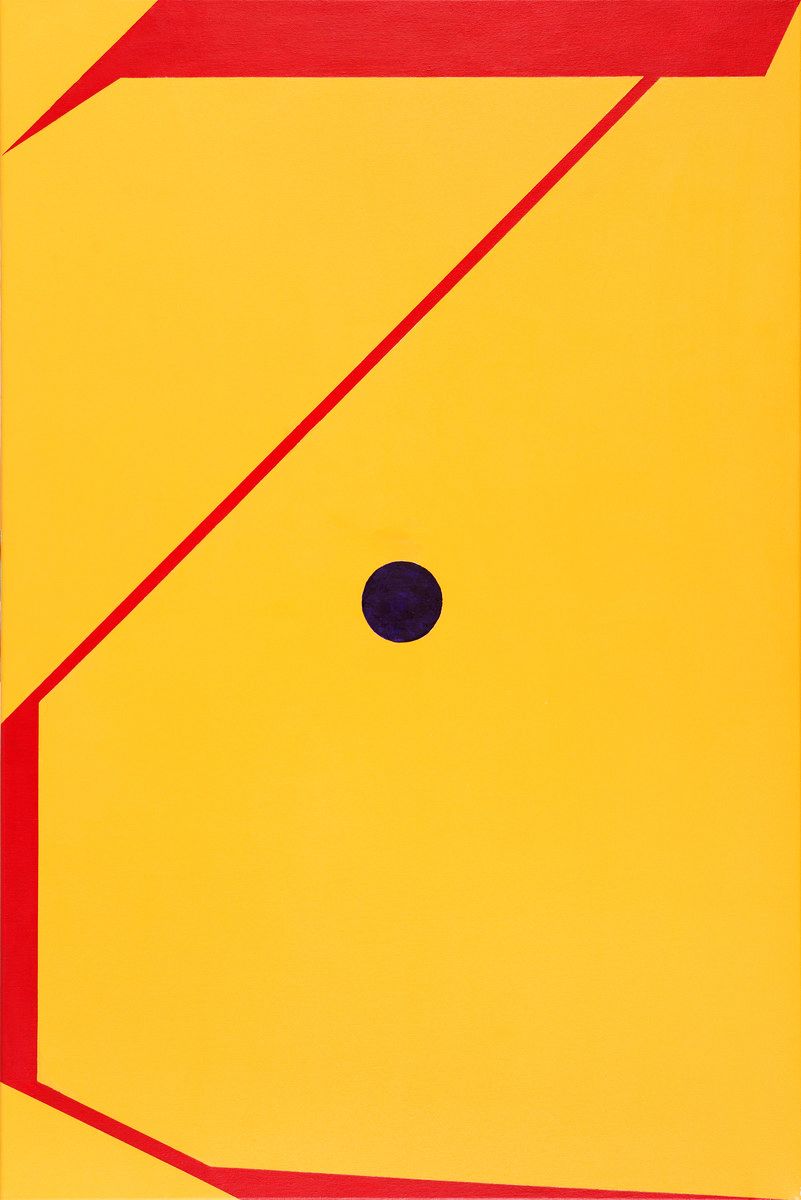
Lebanese artist Samir Sayegh has ignored the calligraphic rules established by Ibn Muqla, stylizing both the geometric and cursive variations of Standard arabic calligraphy. (Supplied)
Lebanese creative person Samir Sayegh has ignored the calligraphic rules established past Ibn Muqla, stylizing both the geometric and cursive variations of Arabic calligraphy. (Supplied)
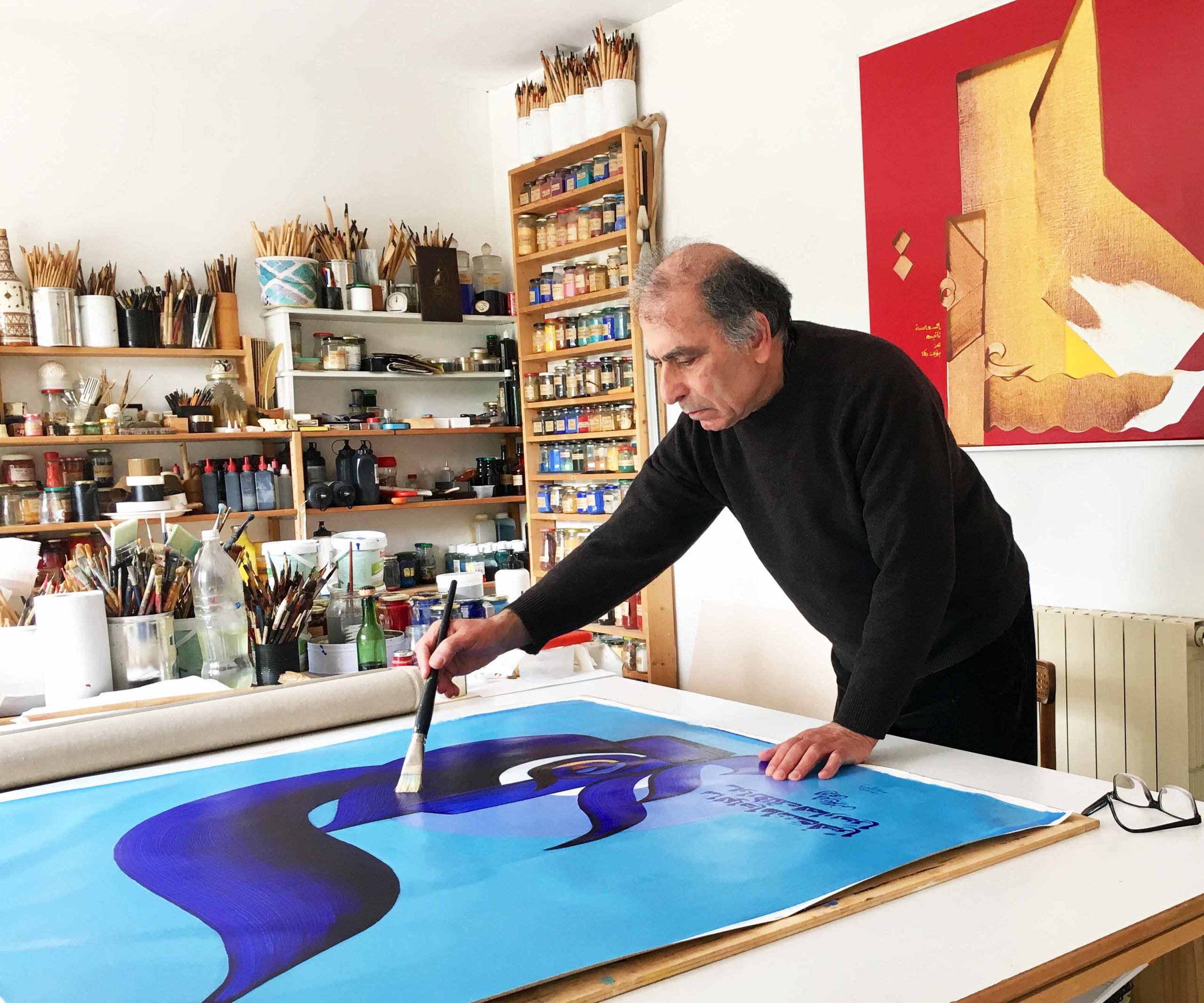
Hassan Massoudy has taken individual letters, words and phrases and created vibrant works of art. (Supplied)
Hassan Massoudy has taken private letters, words and phrases and created vibrant works of art. (Supplied)
Credits
Editors: Saffiya Ansari, Mo Gannon
Artistic director: Simon Khalil
Graphics: Douglas Okasaki
Designer: Omar Nashashibi
Video producer: Eugene Harnan
Video editors: Ali Noori, Farah Heiba
Animation: Wild Studio
Picture researcher: Sheila Mayo
Editorial researcher: Rebecca Anne Proctor
Copy editor: Adam Grundey
Social media: Mohammed Qenan Al-Ghamdi, Hams Saleh, One Carlo Diaz
Producer: Arkan Aladnani
Editor-in-main: Faisal J. Abbas
Special thank you: Taha Al-Hiti
mcadoopeconesuring.blogspot.com
Source: https://www.arabnews.com/ArabicCalligraphy
0 Response to "Islamic Art Includes Elaborate Calligraphy Because It Enhances the Images of People"
ارسال یک نظر